


Reference: 1232


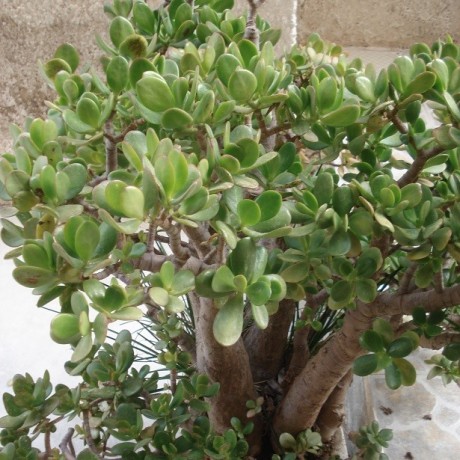
Jade Tree, also known as Jade Plant, Lucky Plant, or Crassula ovata in Latin, is a slow-growing, perennial succulent. This atypical plant originating from South Africa belongs to the Crassulaceae family. It generally measures 80 cm in height and grows with a bonsai-like habit.
Its foliage is dense and fleshy. The smooth, glossy leaves are round, thick, and dark green, often with a slight red tint on the edges. They are arranged in a rosette shape, creating a beautiful symmetry.
Jade tree seeds are black and tiny, not exceeding one millimeter, and are primarily dispersed by the wind. Its star-shaped pink flowers are particularly beautiful and bloom at the end of summer on specimens that are several years old.
Jade Tree is named after the color of its leaves, which resembles the gemstone of the same name. It is an ideal plant for gardening beginners as it is renowned for its ease of maintenance; it is very resilient and requires little water. It is a favorite for both homes and offices.
It is appreciated for its ability to purify indoor air and is typically placed in the southern part of a home. According to Feng Shui, it is considered a lucky plant often associated with prosperity. It is said to attract positive energy, effectively repel negative vibes, and bring financial stability to the household, making it a popular gift for loved ones. It is also sometimes called the Money Tree, Luck Tree, or Friendship Tree.
It prefers a well-draining substrate to promote growth and prevent root rot. An ideal mix consists of 70% cactus soil and 30% draining elements such as sand, perlite, or clay granules. It is recommended to repot every two years to refresh the substrate.
The Money Tree tolerates all types of light exposure; however, it will grow faster if placed in a southwest-facing position. If the nodes between leaf pairs are too far apart (legginess), the plant lacks light. If the leaves turn red, it is receiving too much direct sun.
It easily withstands temperatures near 40°C. However, it cannot tolerate cold as it is frost-sensitive. Its USDA hardiness zone is 9-11.
As a succulent, it stores water in its leaves and stems. Watering should be sparse: once a week during summer and once every 15 days in winter. If the base withers, it is severely underwatered. Conversely, if the base becomes soft/mushy, you must take cuttings immediately to save the plant.
The Luck Tree can be propagated by seed, layering, or more simply by stem or leaf cuttings (using the "smothered" or high-humidity method).
The Friendship Tree generally has no known pests or diseases; it is a very hardy and easy-to-grow plant.
It is occasionally necessary to remove old yellow leaves that fall to the ground; this is the only maintenance required for this indoor plant.
Your review appreciation cannot be sent
Report comment
Report sent
Your report cannot be sent
Write your review
Review sent
Your review cannot be sent
Reference: 0156
Reference: 1161
Reference: 0236
check_circle
check_circle


