


€3.99
Reference: 1232


Common Poppy, also known as Field Poppy or Corn Poppy, is an annual dicotyledonous plant from the Papaveraceae family. It is native to Europe and North Africa. It grows relatively quickly and reaches a height of 40 to 60 cm. It is a lovely little herb that often grows in cereal fields or along sidewalks.
Its foliage is fine and delicate, composed of crumbled leaves divided into deep lobes. They form a rosette at the base of the plant, with upright stems bearing smaller, more divided leaves. The texture is soft and velvety, giving the plant a light and airy appearance.
Corn Poppy flowering is characterized by magnificent bright red flowers, often with a black spot at the base of the petals. The flowers are large, with four slightly wavy petals, which open in summer. Their colorful radiance contrasts beautifully with the fine foliage.
Its fruits are small cylindrical capsules, called schizocarps, which form after flowering. When they ripen, they open to release numerous small seeds.
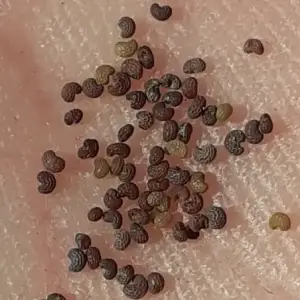
Common Poppy seeds from Papaver rhoeas are round, fine, sand-like, and easily dispersed by the air. They are light brown in color.
Sometimes wrongly considered a weed of cereal fields, corn poppy possesses significant medicinal, culinary, and ecological properties.
It is a distant cousin of the opium poppy, hence its name "field poppy." It is milder than Papaver somniferum. It contains alkaloids (rhoeadine), thus offering relaxing and soothing virtues.
Traditionally, dried petals are used to make herbal teas and syrups. It is also used in the form of lozenges. It is present in phytotherapy and traditional herbalism. Do not use for medicinal purposes without seeking medical advice.
Field poppy is highly appreciated for its natural and rustic appearance and integrates easily into the creation of wild or natural gardens. It has the ability to cover poor soils, bringing color to landscapes that are sometimes neglected. It adds a vivid touch to annual flower mixes and is perfectly suited for creating flowering meadows. It offers a significant amount of pollen, thereby attracting bees and bumblebees.
Even though they are smaller than those of some other poppies, its seeds are used in baking or to make flavored breads.
Field poppy prefers light, well-drained, and low-fertility soil. It often thrives on sandy, clayey, or loamy soils, even those poor in nutrients.
It likes sunny or slightly shaded locations, but it thrives best in full sun for optimal flowering.
Corn poppy is very hardy, withstanding temperatures that can exceed 35°C. It grows mainly in temperate regions.
It requires little watering. Well-drained soil only needs moderate watering once a week, except during prolonged droughts or during flowering.
It reproduces mainly through spontaneous or controlled sowing. Unfortunately, it cannot be propagated by cuttings.
Common poppy is rarely attacked by pests, but it can fall victim to aphids or fungal diseases if conditions are too humid or poorly ventilated.
Your review appreciation cannot be sent
Report comment
Report sent
Your report cannot be sent
Write your review
Review sent
Your review cannot be sent
Reference: 0215
Reference: 0133

check_circle
check_circle


